Frequently asked questions
Can a machine be monitored without touching its PLC?
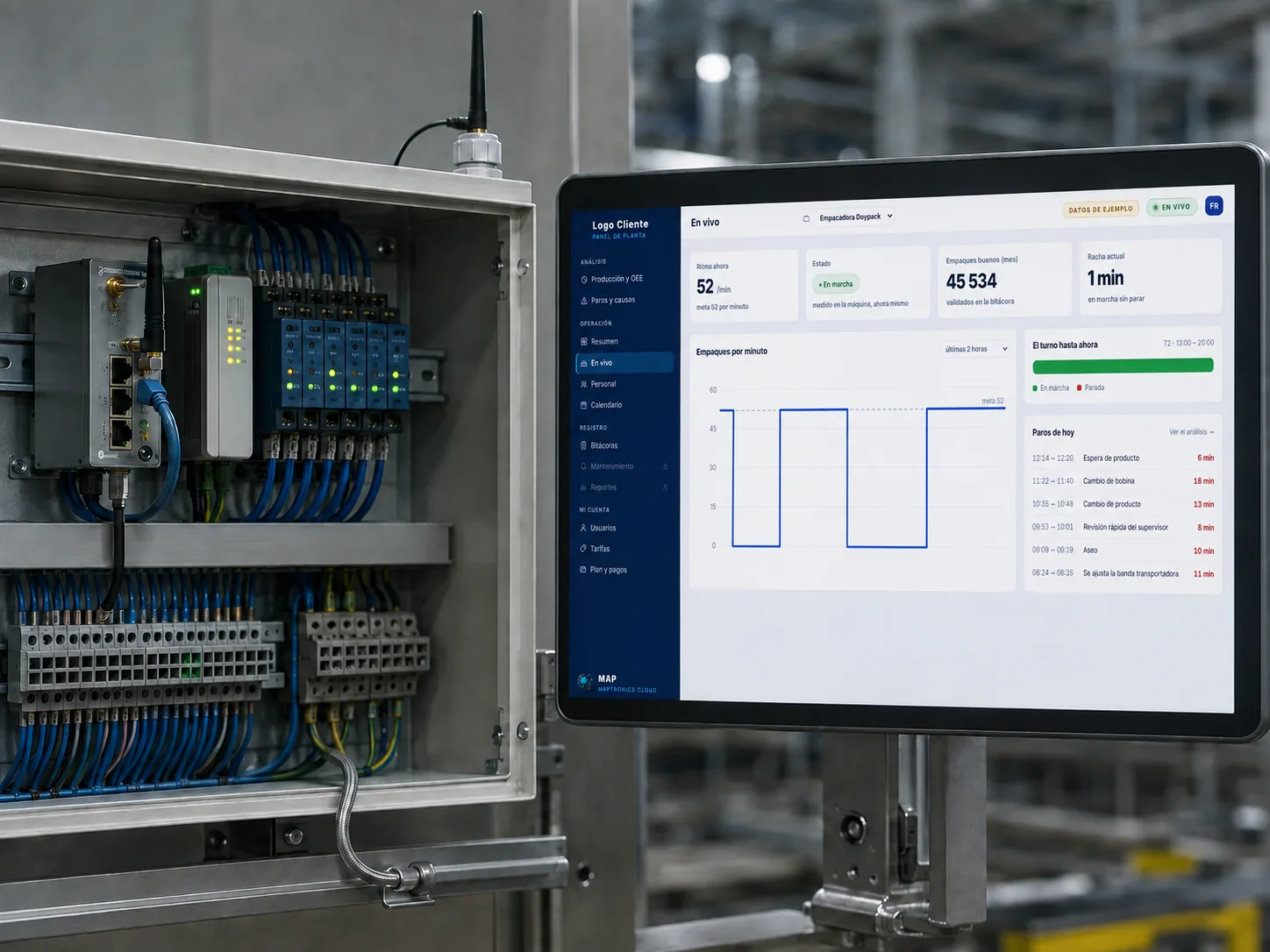
Yes, and that is how we work. We install an industrial gateway that records what the machine produces and sends it to the platform without touching the control system. In our reference installation — a packaging machine at a food plant in Colombia — the gateway counts every bag without the machine control being modified.
How do I know how many units my machine is producing without stopping the line?
The machine ends up counting every unit it produces, and reading it interrupts nothing: the data is available live while the machine keeps working. The installation is scheduled with the plant so it does not interfere with production.
What is an industrial gateway and what is it for?
It is the device that connects to the machine, records what it produces and sends it over the internet to a platform where you can see it. It is the piece that turns an isolated machine into a connected one, without replacing its control system.
What happens if the plant loses power or internet?
The accumulated count is not lost: the equipment keeps it and picks up again when the connection returns. And the dashboard tells a transmission gap apart from a real machine stop, so hours without power do not pollute your indicators.
Where can I see the information?
From a phone or a computer, with 24/7 access from anywhere. You see units per minute, the monthly total and live machine status.
Is the information transmitted securely?
Yes. Communication between the equipment on the plant floor and the platform travels encrypted, from the plant to the panel.
Do you need to visit the plant every time the equipment is updated?
No. The equipment supports remote updates, so adjustments and improvements are applied without travelling to the machine.
How do I stop keeping shift logbooks on paper?
Logbooks are filled out and approved on a web portal, and every stop is logged automatically with its duration. That replaces the handwritten record at the end of the shift, which is where short stops get lost.
What is predictive maintenance and how does it differ from preventive?
Preventive maintenance acts on a fixed calendar. Predictive maintenance uses the data the machine keeps producing to anticipate a failure before it happens, so the intervention happens when the data justifies it rather than when the schedule says so.
How are stops and their causes recorded?
Stops are detected automatically from the machine: nobody has to write them down. The operator adds the reason from their phone —the catalogue of causes is tailored to the plant— and very short stops are counted separately as micro-stops. The result separates what depends on the operator, what the company ordered, and what was a machine failure or a power cut.
Can I know whether I will hit the monthly target?
Yes. The dashboard compares accumulated real production against the target and projects the month-end close based on the current pace and the working days left, using the Colombian calendar and its holidays. The monthly chart only shows validated production, not estimates.
Is OEE calculated?
Real speed, productive time and losses by cause are calculated — the components of OEE. What matters is not the acronym but the separation: how long the machine was on, how long it was actually producing, and where the remaining minutes went, cause by cause.
How is this different from a monitoring platform that is software only?
We also provide the hardware. The data is born in an industrial gateway that we install and answer for: if the data stops coming, that is our problem, not an empty field somebody forgot to type. A software-only platform depends on someone else capturing the data; here the capture is automatic and continuous.